The Anandi Bai Joshi Quilt

Exploring the unexpected encounter with an American quilt in a Pune (India) museum, this post delves into the surprising techniques, historical connections, and personal curiosity that led me to uncover the story of Anandi Bai Joshi, India’s first woman to earn a Western medical degree, and the unique quilt made by her American friends.

Kiran Java

12/5/20253 min read

Having seen a variety of American quilts during my time in the US and the Middle East at quilting shows and in reference books, I became quite familiar with many techniques and styles. Then there was my mother’s long obsession with making quilts that brought a flurry of quilting reference books, fabric, and quilting supplies into our home. Terms like Rose of Sharon, Log Cabin, Lone Star of Texas, invisible applique, piecing method, and trapunto technique were learnt with unexpected ease, even though I never intended to.


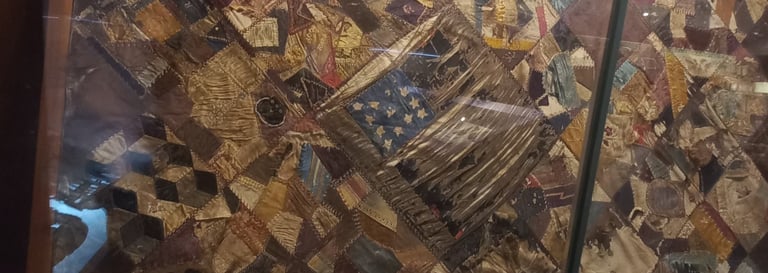
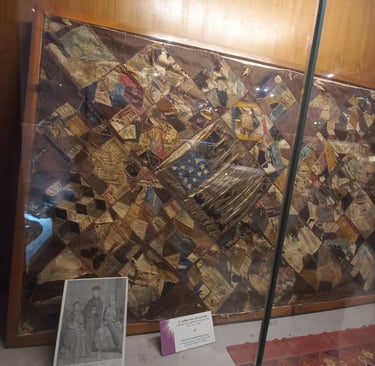
And now here I was in the textile gallery of the Raja Dinkar Kelkar Museum, Pune, looking at an American quilt that took me by surprise because its technique was so different from the ones I had seen before. I studied the text label once again because it contained essential identification and contextual information that I hoped would provide some clues. Although the quilt was donated by Wrangler Paranjape, it was actually quilted by American friends of Anandi Bai Joshi as a gift for her.

What actually surprised me was the zig-zag sewing and asymmetrical patches. It looked haphazard and was distinctly visible! Hence, I couldn't be blamed if I doubted its authenticity.

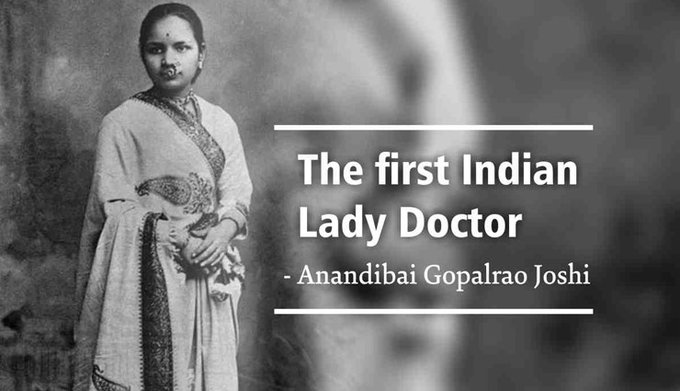
When I returned home, I began my independent research. I discovered that Anandi Bai Joshi (1865–1887), the first Indian woman to earn a degree in Western medicine, had graduated from the Woman’s Medical College of Pennsylvania in 1886. She returned to India the same year.

I then turned my attention to quilting techniques popular in the early 1880s. What I found fascinated me. The 1880s was a time period when a new genre of quilts started to emerge and this trend lasted for the next 20 years! These were quilts, created not for warmth but for their artistic and design significance. It offered women a rare creative license or freedom that allowed them to break conventional quilting rules. These were made with irregular pieces of fabric and the fabric itself was silk, satin, or another luxurious kind. It was meant to be on display. The style and technique were an amalgamation of Japanese art and English embroidery.


The inspiration for this new style came from a famous world exposition held in 1876 in West Fairmount Park, Philadelphia. The Centennial Exposition, celebrating the 100th anniversary of America’s Declaration of Independence, featured participants from 35 countries and thousands of U.S. businesses, showcasing innovations like the telephone and typewriter. For many Americans, it provided their first widespread exposure to Japanese art, particularly ceramics with crackled glazes, which soon became a key design influence. It was this exposure that inspired the asymmetrical and fragmented designs characteristic of these quilts. The style was termed the crazy quilt and became a sensation.

The Anandi Bai Joshi quilt is, therefore, both a piece of American craftsmanship and a cultural icon while also having the sentiment of a token of friendship.

For such a historic quilt, preventive conservation is crucial to ensure its long-term preservation while on display. We should aim to:

Maintain stable temperatures around 22°C and avoid fluctuations. Keep RH around 50% as fluctuations can cause fibers to expand and contract, leading to breakage. Light fades colors and weakens fibers; hence, we keep UV-filtered lighting at low levels (50 lux) and avoid direct sunlight. Avoid attaching directly with pins or staples in the display, and use a supported padded backing if possible. Avoid permanent display and rotate the quilt to keep it out of the light. Keep detailed documentation and photos.

About the author:

Kiran Java holds a Master’s degree in Mass Communication and has over 30 years of international corporate communications experience. She is an independent researcher and a published author with books on sacred stories and the performing arts. A member of both the Museum Association of India and the Indian Association for the Study of Conservation of Cultural Property (IASC), she is currently pursuing studies in Preventive Conservation at the Bhandarkar Oriental Research Institute. Kiran is on a mission to write a series of articles aimed at helping collectors protect and preserve their treasured collections, while also raising awareness of the diversity of Indian culture.

COMMENTS:

Dr. Hiren Shah, Houseum, Ahmedabad | 6th December 2025

A brilliant research note, beautifully observed and beautifully crafted. The quilt itself carries the profound weight of Indian heritage: originally belonging to India’s first qualified lady doctor, later cherished by a legendary Pune mathematician, and now gracing the collections of one of India’s largest one-man museums. Kudos to Kiran Java for your keen eye, meticulous work, and deep knowledge that helped ‘un-weave’ the story of this American quilt and unravel it for all of us. Thank you! Hiren Shah

Do leave your comment or feedback. Thank you

Appreciate your feedback!